California law protects pedestrians at both marked and unmarked crosswalks, yet many drivers remain unaware of the critical legal distinctions between these two types of pedestrian crossing areas. An unmarked crosswalk exists at every intersection where sidewalks meet, regardless of whether painted lines or signage are present. Drivers must yield to pedestrians in both marked and unmarked crosswalks, though the absence of visible markings often leads to confusion and, tragically, serious pedestrian accidents.
Understanding these laws becomes especially important given California’s pedestrian safety record. The legal framework treats both crosswalk types with equal weight, meaning drivers face the same liability whether striking a pedestrian in a clearly painted crossing zone or at an unmarked intersection corner.
What Defines an Unmarked Crosswalk Under California Law?
California Vehicle Code Section 275 establishes the legal definition of a crosswalk as “the portion of a roadway included within the prolongation or connection of the boundary lines of sidewalks at intersections.” This definition creates crosswalks by default at nearly every intersection where sidewalks exist on both sides of the street, even without any painted lines, signs, or other visual indicators.
An unmarked crosswalk extends from one corner of an intersection to the opposite corner, forming an invisible but legally recognized pedestrian right-of-way. These areas receive the same legal protections as their marked counterparts, with Vehicle Code Section 21950 requiring motorists to yield the right-of-way to pedestrians within any crosswalk.
How Marked Crosswalks Differ From Unmarked Crosswalks
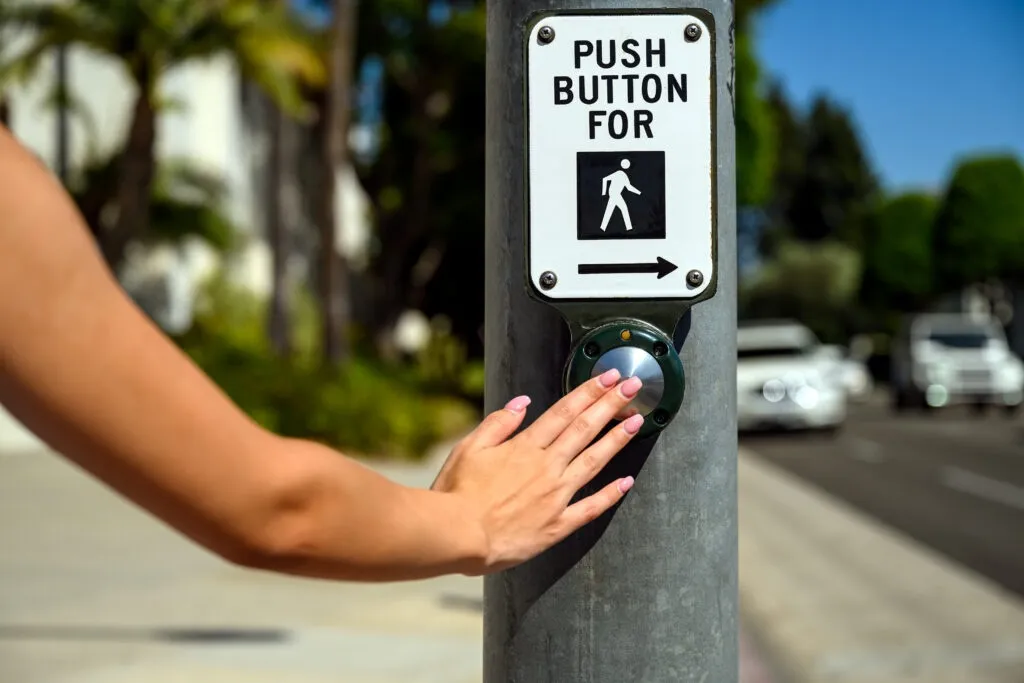
Marked crosswalks feature visible indicators such as painted lines, textured pavement, or crossing signals alerting both drivers and pedestrians to designated crossing areas. Transportation departments typically install these markings at high-traffic intersections, school zones, commercial districts, and areas with significant pedestrian accident risks.
Despite differences in appearance, California law provides identical right-of-way protections at both types of crosswalks. A driver who fails to yield faces the same Vehicle Code violation whether the crosswalk displays bright yellow paint or remains completely unmarked. The legal duty to watch for and yield to crossing pedestrians applies equally across all intersection crossings where sidewalks exist.
Common Scenarios Where Unmarked Crosswalk Accidents Occur
Right-turn collisions at unmarked crosswalks represent a particularly dangerous scenario throughout California communities. Drivers focusing on oncoming traffic while executing right turns on red lights frequently fail to check crosswalks for pedestrians. This pattern proves especially hazardous in areas where pedestrian traffic remains relatively sparse, leading drivers to develop false expectations of empty crosswalks.
Residential intersection accidents occur when drivers treat quiet neighborhood crossings as less significant than major roadway intersections. Poor lighting conditions compound unmarked crosswalk dangers during evening and early morning hours. Without painted lines to catch headlight beams, pedestrians crossing at dusk or dawn may remain nearly invisible to approaching drivers.
Legal Responsibilities of Drivers at Unmarked Crosswalks
California Vehicle Code Section 21950 establishes absolute priority for pedestrians within crosswalks, mandating drivers to yield the right-of-way whenever a person crosses within the roadway boundaries of any marked or unmarked crosswalk. This duty requires drivers to slow or stop as necessary to allow pedestrians to cross safely, not merely to avoid striking them.
Drivers approaching intersections must actively scan for pedestrians who may be preparing to enter or are already within unmarked crosswalks. At controlled intersections with stop signs or traffic signals, drivers must verify crosswalks remain clear before proceeding. The requirement to yield applies regardless of whether a pedestrian has yet entered the driver’s traffic lane.
How Callahan & Blaine, PC Handles Pedestrian Crosswalk Cases
Callahan & Blaine, PC brings 40 years of trial experience and resources to every pedestrian injury case. Our investigation teams deploy within hours of learning about serious crosswalk accidents, documenting scene conditions before evidence degrades or disappears. We engage traffic engineers, accident reconstructionists, and biomechanical experts who reconstruct collision dynamics and establish how intersection geometry created legal crosswalk boundaries.
Managing Partner Edward Susolik has handled over 1,500 mediations during his 33-year career, bringing a deep understanding of how insurance companies evaluate crosswalk injury claims. Understanding your rights at unmarked crosswalks can mean the difference between full recovery for your injuries and bearing catastrophic expenses alone. Contact our office today to discuss your pedestrian injury case.