What a Spinal Cord Injury Claim in San Diego Involves
A San Diego personal injury claim arising from a spinal cord injury is among the most consequential civil cases a victim can pursue. Damage to the spinal cord can disrupt communication between the brain and the body, resulting in partial or complete loss of movement, sensation, and autonomic function below the injury level. These are not temporary conditions. Even an incomplete injury can permanently alter a person’s ability to work, drive, maintain relationships, and live independently.
At Callahan & Blaine, PC, our attorneys have represented catastrophic injury victims across Southern California for more than 40 years. We bring deep trial experience, substantial resources, and a full understanding of how insurers evaluate and dispute high-value spinal cord injury claims. If another party’s negligence caused your injury, the attorneys at Callahan & Blaine, PC are prepared to build, litigate, and try your case.
Common Causes of Spinal Cord Injuries in San Diego
Spinal cord injuries arise across a range of accident types. San Diego’s high traffic density, active construction environment, and proximity to Interstate 5, Interstate 8, and State Route 163 create recurring conditions for serious motor vehicle collisions. Common causes our attorneys handle include:
- Motor vehicle collisions: Car accidents, truck accidents, motorcycle crashes, and pedestrian knockdowns are the leading causes of traumatic spinal cord injuries in California. The forces involved in a high-speed collision or rollover can fracture or dislocate vertebrae and compress or sever the spinal cord.
- Slip and fall incidents: Falls from heights — on construction sites, from scaffolding, or on commercial properties with improperly maintained surfaces — can produce hyperflexion or hyperextension of the spine severe enough to damage cord tissue.
- Premises liability: Property owners who fail to maintain safe conditions are legally responsible for injuries that result. Negligent security, inadequate lighting, and failure to remediate hazards can each contribute to a fall that causes spinal cord damage.
- Aviation and transit accidents: High-impact aviation events, bus collisions, and transit system accidents can produce catastrophic spinal trauma, particularly for occupants who are not properly restrained.
Types of Spinal Cord Injuries and Their Legal Significance
The legal value of a spinal cord injury claim depends substantially on the injury’s classification. Physicians categorize spinal cord injuries by anatomical level — cervical (neck), thoracic (upper and mid-back), lumbar (lower back), and sacral (pelvic region) — and by whether the injury is complete or incomplete.
A complete injury eliminates all motor and sensory function below the lesion site, producing paraplegia when the lower thoracic or lumbar cord is involved, or tetraplegia (quadriplegia) when the cervical cord is affected. A incomplete injury preserves some degree of function and presents a wider range of outcomes, from mild sensory deficits to substantial motor impairment. Both classifications carry significant lifetime medical cost projections, which our attorneys document carefully with the assistance of medical consultants and life-care planners.
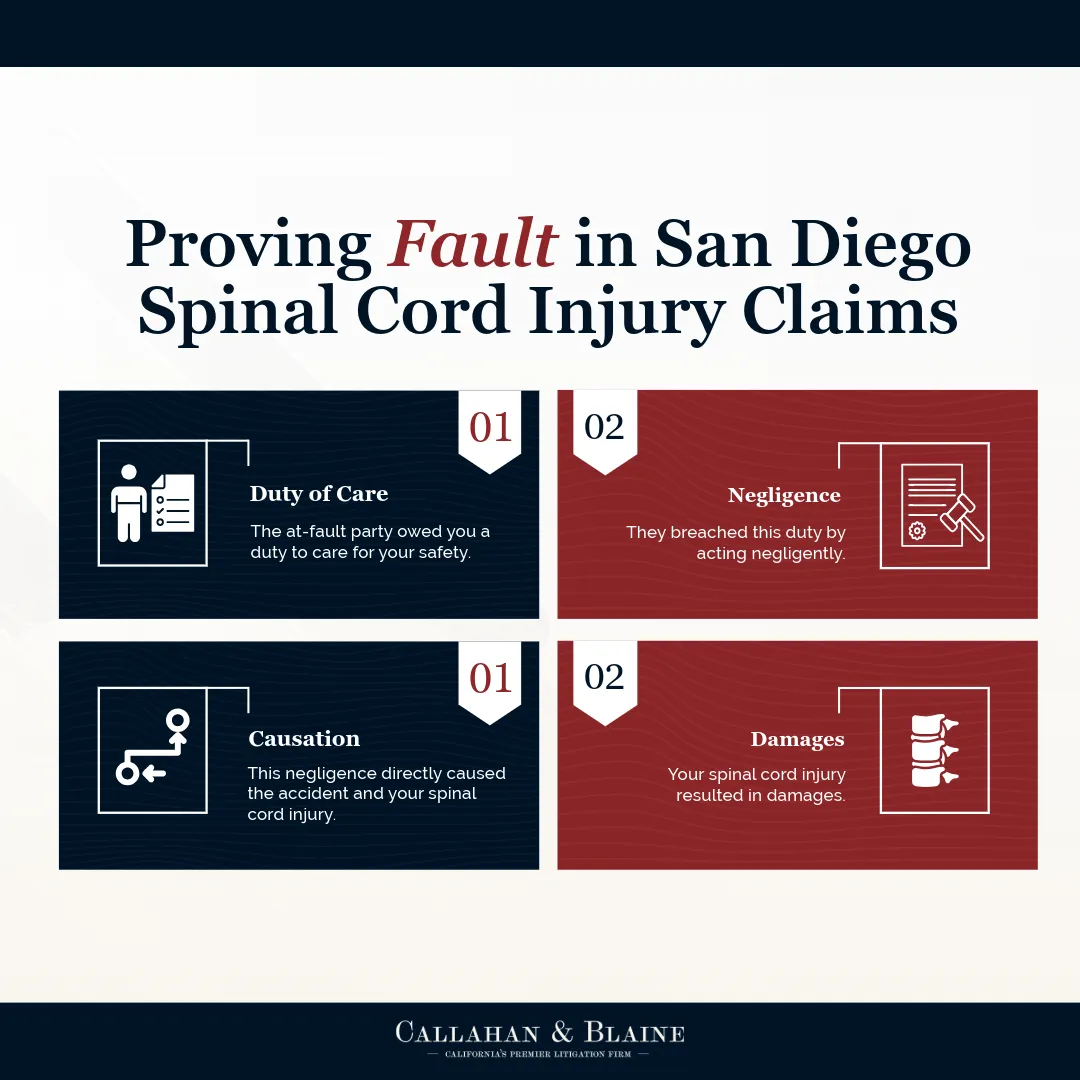
Proving Fault in a San Diego Spinal Cord Injury Claim
Establishing liability in a spinal cord injury case requires demonstrating four elements of negligence. Our attorneys conduct thorough investigations to develop the evidence needed to satisfy each element of your burden of proof.
Duty of Care
The at-fault party owed a legal obligation to act with reasonable care toward you — as a driver, property owner, or employer.
Breach
They failed to meet that standard — through distracted driving, failure to maintain safe premises, or violation of safety regulations.
Causation
Their breach directly caused the incident that produced your spinal cord injury, as supported by medical records, expert analysis, and accident reconstruction.
Damages
Your injury produced quantifiable losses — current and future medical expenses, lost income, reduced earning capacity, and non-economic harm.
Evidence that establishes these elements includes imaging studies and treating physician records, police and incident reports, video footage and witness statements, biomechanical and accident reconstruction analysis, and life-care plans developed by medical consultants. Our attorneys gather and analyze this material promptly, since critical evidence degrades or becomes inaccessible over time.

Compensation Available for Spinal Cord Injury Victims
California law permits spinal cord injury victims to pursue recovery for both economic and non-economic losses. Given the lifelong nature of most spinal cord injuries, accurately projecting future damages is as important as documenting current losses. Our attorneys work with medical consultants, vocational rehabilitation professionals, and economic analysts to build a complete damages picture.
Economic Damages
Emergency and acute care costs, ongoing rehabilitation, assistive devices such as wheelchairs and adaptive equipment, in-home nursing, home modification, and lost wages — both past and projected through the remainder of your working life.
Non-Economic Damages
Physical pain and suffering, emotional distress, loss of consortium, and the diminishment of quality of life that a catastrophic injury inflicts. These damages do not appear on a bill, but they are real and compensable under California law.
Punitive Damages
Where the responsible party’s conduct was malicious or grossly negligent, California courts may award punitive damages as a deterrent, separate from and in addition to compensatory recovery.
How California’s Comparative Fault Rules Apply to Your Case
California follows a pure comparative fault system under Civil Code § 1714. This means your right to recover compensation is not eliminated if you were partially at fault for the accident that caused your spinal cord injury. Your recovery is reduced proportionally by your assigned percentage of fault, but you retain the right to pursue the remaining damages from the responsible parties.
Insurance adjusters routinely attempt to assign a larger share of fault to injured parties in order to reduce settlement exposure. Callahan & Blaine, PC’s attorneys are experienced in countering these tactics with well-documented liability analysis and, where necessary, trial advocacy.
The Statute of Limitations for San Diego Spinal Cord Injury Claims
Under California Code of Civil Procedure § 335.1, you generally have two years from the date of your injury to file a personal injury lawsuit. This deadline applies to most spinal cord injury claims arising from motor vehicle accidents, premises incidents, and comparable negligence. Missing this deadline will bar your claim regardless of how compelling the evidence is.
Two situations can shorten or complicate the standard timeline. First, if a government entity — a city, county, state agency, or transit authority — bears any responsibility for your injury, you must file an administrative claim with that entity within six months of the date of injury under Government Code § 911.2. Failure to do so will foreclose any lawsuit against that entity. Second, if your injury was not immediately apparent, California’s delayed-discovery rule may allow the statute to begin running from the date you discovered — or reasonably should have discovered — the injury, rather than the date of the incident itself.
Because these timelines are unforgiving, we encourage you to consult with an attorney promptly. For authoritative information on California’s civil filing deadlines, see the California Courts Self-Help Guide on Statutes of Limitations. Missing this deadline is irreversible.
What Steps to Take After a Spinal Cord Injury
How Callahan & Blaine, PC Approaches Spinal Cord Injury Cases
Spinal cord injury claims are high-value, factually complex, and vigorously defended by experienced insurance counsel. Our attorneys at Callahan & Blaine, PC have taken catastrophic injury cases from initial investigation through verdict across California for more than four decades. Our approach includes:
Thorough investigation and liability analysis. We identify every responsible party, obtain and analyze medical records and expert reports, engage accident reconstruction professionals where appropriate, and build a factual foundation that will withstand cross-examination at trial.
Full damages development. We work with life-care planning consultants and vocational rehabilitation professionals to project the full cost of your injury — not just current bills but the decades of medical care, assistive technology, home modification, and lost earning capacity that a complete or severe incomplete injury entails.
Experienced insurance negotiation. Our managing partner, Edward Susolik, is one of California’s leading authorities on insurance litigation and bad faith. That institutional knowledge shapes how our attorneys approach valuation, negotiation, and the strategic use of trial-readiness to drive fair resolution.
Trial-ready litigation. We prepare every San Diego catastrophic injury case as though it will go to a jury. Our firm has achieved record verdicts and significant settlements in high-stakes personal injury litigation across California, and we do not shy away from trial when a fair recovery cannot be reached through negotiation.
Attorney Edward Susolik and the Callahan & Blaine, PC Trial Team
Edward Susolik — CEO, President & Senior Trial Attorney
Super Lawyers Top 100 Southern California | Named One of California’s Leading Insurance Litigators
Edward Susolik leads Callahan & Blaine, PC’s catastrophic personal injury practice. With a career built on complex, high-stakes civil trials, he brings an unmatched understanding of how insurance companies evaluate, dispute, and ultimately settle spinal cord injury claims — and how to counter their strategies at every stage of litigation. Read Attorney Susolik’s full profile.
Frequently Asked Questions About San Diego Spinal Cord Injury Claims
Contact Callahan & Blaine, PC to Submit Your San Diego Spinal Cord Injury Case
To speak with a member of our team about your potential spinal cord injury case, Contact Us to Submit Your Potential Case.